n a software development world that’s moving faster each day, it’s hard to deliver consistently with high quality. Traditional testing techniques often have a hard time keeping pace, which causes blockages and slowdowns. This is where TestOps comes to the rescue. It offers a paradigm shift, it works as a game changer that boosts efficiency, teamwork, and overall testing effectiveness.
As software applications get more and more complex, and the need for rapid releases increases, the inadequacy of traditional testing practices becomes starkly obvious. TestOps solves this problem, as it provides a holistic approach that integrates testing into the development pipeline with a seamless experience.
Let’s find out how TestOps can satisfy the needs of today’s software development industry, optimize your workflows, and deliver great software products. Testing's future is TestOps - let's do this transformation together!
What Is TestOps?

The term "TestOps," which stands for "Test Operations," refers to a contemporary method of software testing that incorporates collaboration, automation, and continuous testing techniques. It enables this by managing test environments, automating test execution, and encouraging communication between the development, testing, and operations teams. TestOps works to reduce development cycle delays and errors while ensuring that software systems are extensively tested, dependable, and ready for deployment.
Who Uses It?

It's crucial to understand who benefits from this process before delving into the specifics of TestOps. A wider audience, including developers, testers, and DevOps experts, is catered to by TestOps, which is not exclusive to any particular group. Its collaborative nature fills the gap between these teams and promotes a unified testing strategy.
The four central components of TestOps
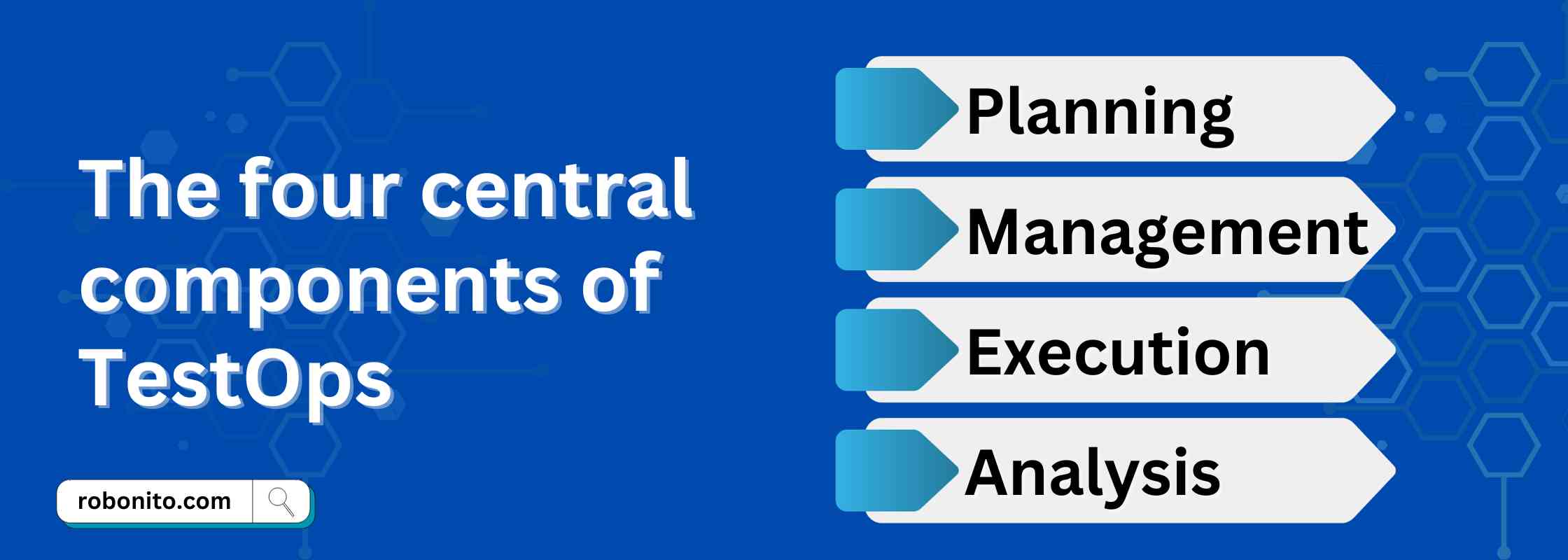
Planning:
Testing operations begin with careful preparation. This involves defining test objectives, scope, and strategies. A well-structured plan guarantees that every aspect of the program is thoroughly assessed and forms the basis for effective testing.
Management:
TestOps' fundamental component is effective test management. It includes planning test dates, allocating resources, and monitoring progress. The alignment of testing efforts with project objectives and deadlines is ensured by this component.
Execution:
The real work begins at the execution stage. By automating repetitive activities, enabling quicker feedback, and minimizing human error, TestOps streamlines the execution of tests. Here, automation is crucial since it makes it possible for tests to run smoothly throughout the DevOps pipeline.
Analysis:
A strong focus is placed on data-driven decision-making in TestOps. Teams learn from test findings, find bottlenecks, and pinpoint areas for improvement through an in-depth analysis. The constant optimization of testing efforts is made possible by this component.
TestOps Features

DevOps integration.
DevOps principles, which combine IT operations (Ops) and software development (Dev) into a single process, are effortlessly integrated with TestOps. Continuous testing and continuous delivery (CI/CD) in software development cannot be accomplished without this combination. It promotes a cross-functional, cooperative strategy by integrating testing with the development and deployment processes. With the help of this integration, every modification to the code is rigorously tested, aiding in the early discovery of bugs and enabling developers to receive feedback more quickly. The total software development lifecycle is accelerated as a result, which lowers the likelihood that serious flaws will enter production.
Enhanced test planning
TestOps improves test planning by offering an organized and team-based method for developing, maintaining, and carrying out test plans. Teams can manage resources effectively due to their tools for specifying test objectives, scope, and requirements. It is possible to organize and prioritize test cases so that the most important and high-impact tests are run first. It is simpler to confirm that every component of the program has been completely tested owing to the traceability features that are frequently included in test operations tools and connect test cases to user stories or requirements. Collaboration is improved through shared access to test plans and real-time updates, enabling all team members to stay on the same page.
Reduced execution time

Through automation and parallel testing, TestOps significantly reduces the time it takes to run tests. Automated test scripts can run simultaneously on different test settings and configurations and can be executed considerably more quickly than manual testing. Testing doesn't become a bottleneck in the development process thanks to the use of TestOps technologies that improve test scheduling and execution. TestOps also reduces the need for extensive rework and debugging by identifying flaws early in the development cycle, speeding up the entire development cycle. In order to fulfill the needs of today's quick-paced development environments, software releases can now happen more frequently and reliably.
TestOps vs. DevOps
DevOps: Software development and IT operations are two distinct disciplines, and DevOps is a collection of principles that aims to eliminate this separation. From the production of code to deployment, it focuses on automating and optimizing the entire software development and delivery process. DevOps places a strong emphasis on collaboration, continuous integration, and continuous delivery to support more rapid and dependable software releases.
TestOps: On the other hand, TestOps is a subset of DevOps that is devoted exclusively to software testing. It incorporates testing procedures into the DevOps pipeline to ensure continuous testing throughout the development process. To eliminate bottlenecks in testing and accelerate the delivery of high-quality software, TestOps places a strong emphasis on automated testing, test environment management, and effective test planning.
Read full article here